- Home
- Tucson Climate
- Tucson Humidity
Humidity in Tucson Arizona
What It Really Feels Like All Year
The humidity in Tucson Arizona gives the people in town (like us) some weather to talk about.
Locals like saying to those who think it's so hot in Tucson "but it's a dry heat." Yet, that's only part of the story. Yes, we're in the Sonoran Desert, an arid area where the air can be so dry your sweat evaporates before you even notice it! Still, we'll tell you about our summer season that brings us humid days.
Understanding humidity in Tucson isn't only about viewing the numbers. Although we'll provide you a chart for that below. Tucsonans think about the actual experience of humidity:
- How your skin feels when you step outside at 7am versus 3pm
- Why the air feels perfect in November but noticeably thicker in July
- How 95°F/35°C can feel totally different, depending on whether it's April or August.
We'll be showing you today's humidity, walking you through Tucson's humidity patterns month by month. But importantly, we'll explore the real sensations from our own experiences (and the relationship to the dew point).
Humidity in Tucson Arizona: A Year-Round Overview
The humidity in Tucson Arizona is mostly dry year-round, making it ideal for outdoor activities in nearly every season.
As you'd note on the chart above, humidity levels can spike near 100% during our monsoon season from July through September. Starting in June, temperatures soar to the upper 90s-102°F (37-39°C). Then in late June and especially July and August, monsoon humidity combined with higher dew points makes it feel quite clammy - even to us locals.
We'll show you how that all works.
How Does Humidity Affect Comfort?
Most people feel comfortable when humidity ranges from 30-60% RH. You likely wouldn't even think about the humidity level.
When humidity is above 60% RH (High Humidity):
- Air feels muggy
- Sweat doesn't evaporate well from your skin
- Air feels warmer than the actual temperature
- Indoors, mold and dust mites can be triggered
When humidity is below 30% RH (Low Humidity):
- Lips and skin feel dry
- Eyes may feel irritated
- Clothes can cling from static
- Throat dries out; you'll feel thirsty more often
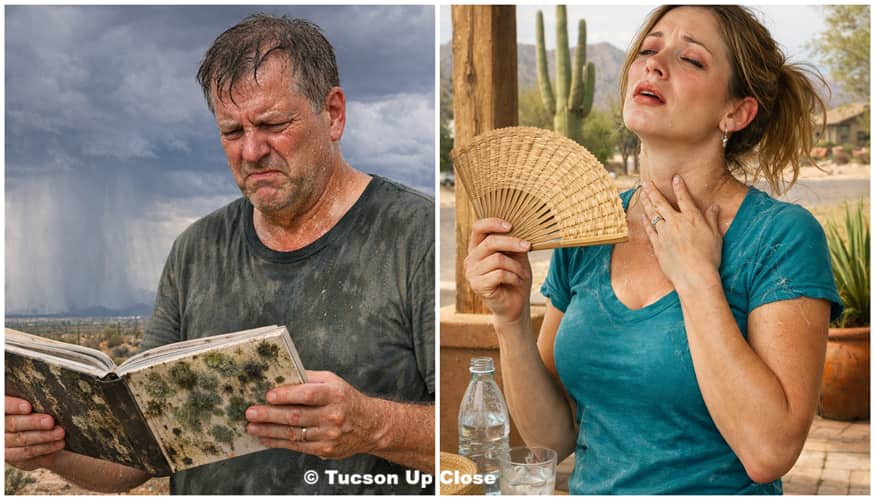 From sticky humidity to very dry air.
In Tucson, we experience low humidity most of the year.
Over time, your body typically adjusts. That's the case for most residents, including us. I remember our first visit to the Southwest, coming from the U.S. northeast. We grew up with horribly humid summers.
We first felt the low humidity in West Texas. We were comfortable, but almost constantly thirsty even though temperatures were only in the 80s°F (27°C range).
Because humidity and dew points stay low for most of the year, Tucson offers these comfortable conditions that humid climates simply can't match.
What Is Relative Humidity?
Think of relative humidity (RH) with this sponge example. Pretend the air is a sponge:
- If the sponge is completely full of water and can't hold any more, that's like 100% humidity. The air holds all the water vapor it can (water vapor is water in gas form, like when you see steam that disappears into the air).
- If the sponge is half full, that's like 50% RH.
Here's the key: warm air can hold more water vapor than cold air. Think of warm air as a giant sponge and cold air as a tiny sponge. That's why summer and tropical places feel more humid, while winter and cold places feel drier.
So 50% humidity when it's hot feels much stickier than 50% humidity in cold temperatures - because there's actually more water in the air.
What Is Dew Point and Why Does It Matter?
First let's use the sponge example we gave above. The dew point is the temperature when the air gets completely full and starts "dripping" out of that sponge.
Or try this: picture a glass of ice water on your patio table on a hot day:
- The air around the glass gets cold from the chilled surface
- Cold air can't hold much water
- So the water vapor turns into droplets on the glass - that's dew
 Cold glass of water on a humid stormy day.
When the weather forecast mentions "dew point," think of it as the "sweat point" temperature. A high dew point means you'll feel sticky because moisture in the air makes it harder for sweat to evaporate from your skin.
Dew point comfort levels
So, dew points measure how humid the air makes you feel - low numbers feel dry, high numbers feel sticky.
- Below 50°F: Comfortable and dry
- 50–60°F: Noticeable moisture
- Above 60°F: Muggy and uncomfortable
- Above 70°F: Very sticky - you'll notice your clothing absorbing and showing sweat
In Tucson, the dew point is usually low (often in the single digits or teens), which is why desert heat feels less oppressive than humid places. Sweat evaporates quickly - that's the famous "dry heat."
Why Is Dew Point More Reliable Than Humidity?
Does Relative Humidity Lie? The Secret Metric: Dew Point
In the desert, the standard Relative Humidity (RH) percentage on the news is sort-of a trickster. It tells you how full of water the air is related to the current temperature, but not how much that moisture affects you.
Consider this: In Tucson, 60% humidity on a 40°F January morning feels crisp and dry. But 40% humidity on a 100°F July afternoon feels like a steam bath. So the Dew Point is the most accurate way to measure your physical comfort.
The difference? Dew point.
Unlike RH, the dew point doesn't change just because the sun comes up and temperatures rise. It measures the actual amount of moisture in the air.
The Takeaway: Pay attention to the dew point rather than humidity percentage. If the dew point is under 50°F, you'll likely be comfortable, almost regardless of the air temperature.
Tucson Humidity by Season - What to Expect
Here's how the humidity around town makes us feel.
Even though we're talking humidity in Tucson Arizona, remember the temperature and the dew point work together to affect how comfortable (or not!) we are. That's a better way then just looking at the humidity in Tucson Arizona.
That may help you plan a trip to Tucson!
Spring Humidity in Tucson, Arizona
March to May: Spring Air is Dry and Pleasant
In Tucson, humidity is low this time of year. With dew points about in the upper 20s-mid 30s°F (-2 to +2°C).
March is dry, April is very dry, and May generally has the lowest humidity & dew point of these three months. These consistently dry desert conditions demonstrate very low dew points throughout these months.
SPRING HUMIDITY & DEW POINT (Averages):
>> March: 30-31% humidity | Dew Point: 29-33°F (-1.7 to 0.6°C)
>> April: 22% humidity | Dew Point: 26-28°F (-3.3 to -2.2°C)
>> May: 16-22% humidity | Dew Point: 32-35°F (0-1.7°C)
Tucson Humidity in June: That Dry Oven-like Heat!
In June the humidity in Tucson Arizona is still low, averaging 19-21%. With dew points reflecting the arid desert air, ranging from 38-45°F (3-7°C).
With the dryness, June is the hottest month in Tucson.
JUNE HUMIDITY & DEW POINT (Averages):
>> June: 19-21% relative humidity
>> June: Average Dew Point 32-45°F (0-7.2°C)
The low humidity affects our hydration needs, skin dryness, and the dangerous chance of overheating when not using common desert sense.
But late June sometimes brings change. You may hear on weather reports that mid-June marks the monsoon season start. But below you'll see locals have a different take on that.
Tucson Summer Humidity
Monsoon Season: July to September
Humidity in Tucson Arizona peaks during the monsoon season in July and August. On an average day, it reaches up to 45%. But dew points are climbing as high as 65°F (18.3°C).
So the air begins feeling more sultry at times. But particularly when a Monsoon rain thunderstorm is near and/or begins.
You've seen above that mid-June starts our monsoon season.
But for most Tucsonans, we've seen over the years July is almost always the starting point. Humidity will begin gradually increasing toward the end of June. But we're waiting for The Dew Point to Reach 54° for three days in a row. Now that's official!
JULY TO SEPTEMBER HUMIDITY & DEW POINTS (Averages):
>> July: 35-40% humidity | Dew Point: 55-62°F (13-17°C)
>> August: (Monsoon Peaks) 40-45% humidity | Dew Point: 58-60°F (14-15.6°C)
>> September: 30-35% humidity | Dew Point: 46-57°F (7.8-13.9°C)
The Monsoon Shift in Tucson
As June becomes July, the upper wind patterns shift (that's the actual definition of "monsoon").
These winds pull moisture into the air from the Gulf of California. When the Dew Point Reaches 54°F in Tucson, that's when locals become excited about anticipating the monsoon.
The local atmosphere has enough fuel (moisture) for our famed lightning storms.
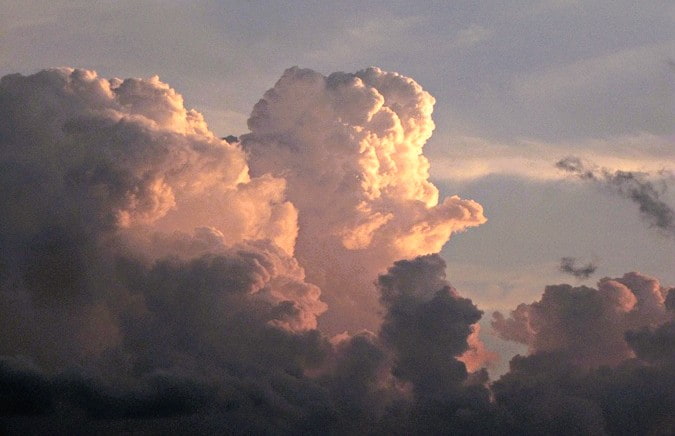 Thunderheads building for a monsoon storm.
As storms roll in, suddenly our dry desert feels like a different place entirely.
- Your shirt clings with stickiness, breathing seems a bit heavier, and shade doesn't quite deliver the relief it did in May. The air is somewhat stickier, but it's sure worth it.
- The temperature difference from morning to afternoon is often smaller that dry months like May and June.
- Cloudier days come around often, seeming to drop the temperature feel a bit, as the sun isn't perceived as so strong.
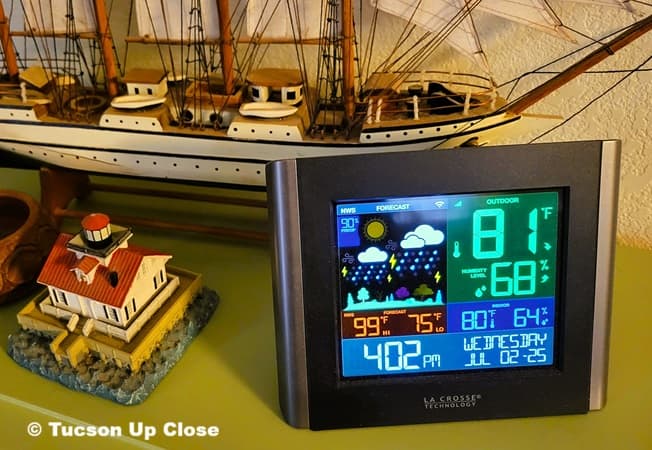 July 2, humidity climbs, monsoon getting ready to begin.
Tucson Fall & Winter Humidity:
Cooler, Moderately Dry for October through February
FALL & WINTER HUMIDITY & DEW POINTS (Averages):
>> October: 29-33% humidity | Dew Point: 35-45°F (1.7-7.2°C)
>> November: 29-36% humidity | Dew Point: 30-35°F (-1.1 to 1.7°C)
>> December: 37-47% humidity | Dew Point: 27-31°F (-3 to -1°C)
>> January: 40-46% humidity | Dew Point: 27-28°F (-3 to -2.2°C)
>> February: 32-43% humidity | Dew Point: 28-29°F (-3 to -1.7°C)
Although the humidity in Tucson Arizona becomes drier in late autumn through winter, it's highest in the mornings (50-60%). It drops significantly in the afternoons (25-35%). Dew points are very low throughout these months. Even below freezing in December through February.
The outdoor air is very dry, yet mostly comfortable. But if the inside heaters come on, the indoor air gets even drier.
Tucson’s fall and winter seasons are mild and very pleasant.
- Humidity averages 29-46%.
- Dew points are low, typically between 27-37°F (-3 to 3°C).
With lower daytime temperatures, and comfortable humidity and dew points, it's the best time for outdoor activities.
During the monsoon season, August is the wettest, most humid month in Tucson. The dew points are highest, at 58-65°F/14.4-18.3°C.
But locals love, love, love the monsoon months. We sure do!
With rainstorms in the area, dew points rise up markedly. Humidity in Tucson Arizona can reach 100% when rain begins. Yet a storm and/or nearby rain can drop temperatures by as much as 30°F/16.7°C.
We get a fantastic light show, along with temperature relief. And sometimes amazing rainbows.
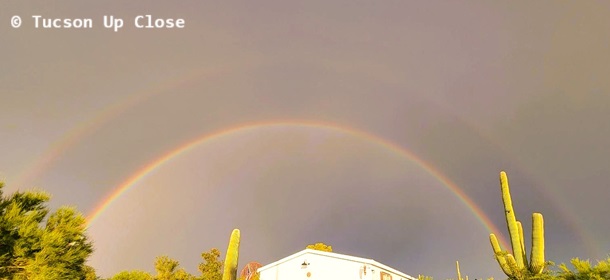 Rainbow over our son's house.
Becoming a double rainbow, which often appears in Tucson's monsoon.
Then a September transition winds down the monsoon. Days bringing rainfall lessen, as humidity and dew point starts the downward trek. Temperatures cool noticeably - especially nighttime lows.
Understanding Humidity's Real Feel in Tucson Arizona
To understand how it would truly feel in Tucson, use the scale below to understand what the dew point temperatures mean for your day in town.
| Dew Point | How It Feels in the Desert | Tucson Situation |
|---|---|---|
| Below 40°F | Bone Dry | Tucson’s standard for most of the year. Very dry air; static electricity is common. |
| 40°F – 54°F | Pleasant | Feels “dry” to most people. Ideal for outdoor dining and sightseeing. |
| 55°F – 64°F | Sticky / Muggy | The monsoon borderline. You begin to notice dampness in the air. |
| 65°F+ | Oppressive | Rare for Tucson, but possible during heavy storms. Feels similar to Florida or Houston. |
Now for a bit more detail, see this Season-by-Season table that combines these dew point ranges with the typical temperatures for the season.
| Season | Typical Temperatures | Typical Dew Point | How It Feels in Tucson |
|---|---|---|---|
| Spring (March–May) | Cool mornings (50s–60s°F / 10–18°C) with warm afternoons (70s–90s°F / 24–34°C) | 29–35°F (−2 to 2°C) | Very dry and comfortable. Desert air feels crisp; ideal for hiking, dining outdoors, and sightseeing. |
| June | Hot afternoons (98–102°F / 37–39°C) with warm mornings in the 70s°F (21–24°C) | 38–45°F (3–7°C) | Hot but still dry. Heat is intense in the sun, but shade and evenings remain tolerable. |
| Summer / Monsoon (July–September) | Consistently hot days (90s–102°F / 32–39°C) with warm nights | 55–65°F (13–18°C) | Noticeably humid at times. Air can feel sticky or muggy during monsoon storms, especially in July and August. |
| Fall & Winter (October–February) | Mild days (60s–80s°F / 16–31°C) with cool mornings in the 40s–50s°F (4–15°C) | 27–37°F (−3 to 3°C) | Dry, crisp, and comfortable. Cool mornings, sunny afternoons, and minimal humidity. |
Tucson Humidity Compared to Other Cities
How does Tucson's humidity stack up against other popular destinations?
Whether you're comparing it to cities like Miami or Houston, or other desert locations like Phoenix and Las Vegas, understanding the humidity in Tucson Arizona helps you prepare for what to expect.
We'll break it down for you so you can have insight for how various cities' humidity feels like.
Humidity in Tucson vs Phoenix
Tucson and Phoenix both have desert-dry humidity most of the time. But changes to a clammy feel with monsoon humidity.
- Tucson morning humidity averages a little more humid than Phoenix (about 53% vs 51%).
- Tucson afternoons are also a touch higher (about 25% vs 22%)
So the humidity in Tucson Arizona is slightly higher overall, but not dramatically so that you'd notice a difference.
In a rating scale, if Phoenix feels 10/10 dry, Tucson is more like 9/10 dry. The dew point milestone is nearly the same: around 54°F in Tucson vs 55°F in Phoenix.
During monsoon surges, both cities have days that feel jungle-like.
Tucson Up Close is made possible by readers like you. This article contains affiliate links, which means we may earn a small commission if you purchase through them - at no extra cost to you. Thanks for your support! Learn more →
WHY NOT EXPERIENCE THE "DRY HEAT" OF THE SONORAN DESERT
Here is Tucson - You Should GO!
Try a Trip to the Phoenix Area>
Las Vegas Also Has It That Low Humidity
Dry and Wet at Lake Havasu City AZ
Tucson's Humidity vs a Regularly Humid City
Are looking to escape your city's very humid air?
Let's compare a humid city's feel to the humidity in Tucson Arizona, so you can see if it will work for you.
Will you be visiting from Miami, or a similar climate? Tucson’s average humidity is about half (38% vs 73%) of Miami's.
- In Tucson, you'd experience that “dry heat” feeling, because Tucson’s average dew point is around 36°F. Tucson usually feels crisp, and sweat evaporates fast (except spiking during monsoon).
- In Miami the typical dew point averages around 67°F. Miami air often feels damp and oppressive, even in the shade.
Will you be visiting from Houston? Similar story.
- Houston averages about 71% humidity.
- With a dew point around 61°F.
Brownsville is another humid Texas city.
- They average around 74% humidity.
- The dew point is usually 66°F.
These three cities feel much muggier than Tucson.
DO YOU WANT TO SEE FOR YOURSELF? BASK IN THE SULTRY AIR!
We've Been Momentarily in Miami - You Should Try It>
We've Traveled Through Houston - It's an Experience to Have!
Now Brownsville - It is Worth The Trip! Go Ahead>
We were On South Padre Island, near Brownsville. I don't know if we've ever felt such humidity. Even our hotel bed linens and floor felt damp!

Tucson vs a Coastal or Midwestern City
Coastal Southern California (think Los Angeles/San Diego) feels “ocean-humid” compared to Tucson.
Tucson averages about 38% humidity, while Los Angeles averages about 71% and San Diego about 69%. So the coast is roughly twice as humid on paper. But the feel is different:
- SoCal’s humidity often comes with cooler marine air, while Tucson’s dryness makes heat feel more “crispy” most of the year.
- Dew points show the real difference:
- Tucson averages about 36°F
- While coastal SoCal runs around 50–52°F, so the air holds noticeably more moisture.
A Typical Midwest City like Chicago where dew points swing a lot.
- But summers commonly feel heavy because dew points often jump into the 60s, sometimes higher.
- While Tucson only gets that kind of suffocating air during monsoon pushes.
WHAT TYPE OF FEEL DO THESE PLACES HAVE? SEE FOR YOURSELF!
Living With Tucson’s Dry Desert Air
Tucson’s low humidity - about 38% on average, and often far lower - is something residents adapt to quickly. While the dry air has clear advantages, it does mean some adjustments for comfort at home and for your body.
Most locals like us aim to keep indoor humidity between 30% and 50% to stay comfortable year-round.
How Tucson Locals Manage Indoor Dryness
As do most of us Tucson locals, we use use several practical strategies to balance the desert air indoors:
- Use A Cool-Mist or An Ultrasonic Humidifier, especially during the dry winter months, in bedrooms and main living areas.
- Grow indoor plants like Spider Plants, Boston Ferns, or Potted Palm Trees. They naturally release moisture and improve air quality.

- Seal air leaks around windows and doors, and change HVAC air filters monthly.
- Schedule seasonal HVAC maintenance to for efficiency and comfort.
- During monsoon season, some households even use a dehumidifier to manage short-term moisture increases. We haven't done that, so can't say if it's worth it!
MANAGE ARIDITY AND HUMIDITY WITH THESE ITEMS:
How Tucson’s Low Humidity Affects Your Body
Very dry air - sometimes below 20% humidity - draws moisture from your body and can cause:
- Dry, cracked, or irritated skin.
- Parched nasal passages, sinus discomfort, congestion, or occasional nosebleeds.
To counteract these effects, we recommend:
- Applying High-Quality Moisturizers without mineral oil, especially right after showering.
- Staying well hydrated with 8-10 glasses of water daily. Bring Your Water Bottle to carry more when outdoors or active.
- Using Saline Nasal Spray morning and night. We do that, and Recommend What We Use>
- Lip Balm is also essential. We Recommend This Organic 6-Pack.
MANAGE ARID HEAT AND HUMIDITY WITH THESE ITEMS:
How Low Humidity Affects Your Home
Dry desert air also impacts household materials:
- Increased static electricity, especially when touching fabrics or metal.
- Wood furniture, floors, and musical instruments may crack, warp, or develop gaps as moisture escapes
Home Cooling & HVAC Considerations in Tucson
Evaporative coolers - often called “swamp coolers” - have long been popular in Tucson. They work especially well during the dry warm months from March through June, using evaporating water to cool the air while consuming less energy than traditional air conditioning.

However, once monsoon humidity rises above 30%, evaporative cooling becomes far less effective. This is why many Tucson homes now rely on conventional air conditioning during summer for consistent comfort.
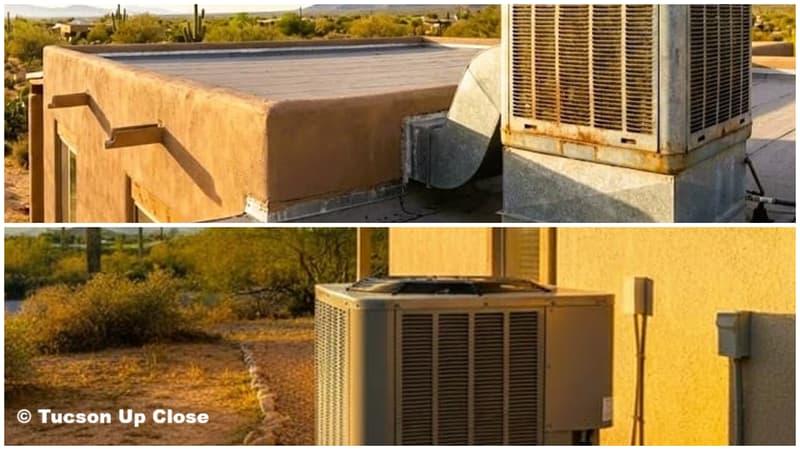 Swamp Cooler VS Air Conditioner - we've had homes with both. We choose the AC!
Despite the dryness, many residents consider Tucson’s climate a major benefit:
- No muggy or sticky feel, even in summer
- Minimal mold concerns
- A crisp, clean desert atmosphere
Whether you’re visiting, relocating, or living here full time, the dry air simply requires a short adjustment period.
Visiting Tucson: Humidity, Comfort & Packing Tips
Tucson’s dry climate surprises many first-time visitors. Especially for those arriving from humid regions.
Visiting Tucson From a Humid Climate?
If you’re coming from Florida, the Gulf Coast, the Pacific Northwest, or other humid areas, Tucson’s air will feel dramatically different.
The familiar sticky heaviness disappears, and sweat evaporates almost instantly. That effect makes 95°F/35°C feel more comfortable than 85°F/29°C) back home.
That said, the dryness comes with surprises:
- Lips chap quickly.
- Contact lenses may feel gritty.
- Glasses can fog up going from outdoors to indoors. Here's Our Local Solution Tip for That!
- You may wake up with a dry throat.
- Hair loses frizz but gains static.
- Laundry dries outdoors in hours, not days.
- Alcohol affects you faster due to dehydration.
- The refreshed feeling after a shower fades quickly.
Be sure to pack lip balm (This One's Popular With Men>), hydrating lotion (We've Been Using This One & Love It), and eye drops (Bill Uses This and He Says It's Excellent!). You’ll need these item sooner than expected!
Best Months to Visit Tucson for Comfortable Humidity
The most comfortable time to visit Tucson is October through May, when humidity and dew points are low and temperatures are pleasant.
Late spring and early summer (May-June) bring very dry heat that many travelers find more tolerable than humid summer weather elsewhere. But remember, hydration is critical. Always carry water and use sunscreen daily. We Like This One - See If It Suits You>
If you’re visiting during monsoon season (mid-June through September):
- Expect higher humidity and brief afternoon storms.
- Pack light, breathable clothing
- A light rain jacket could be useful. (We Got These, Easy to Pack, and Saved Us From Being Soaked in Roatan Honduras!)
- Plan outdoor activities for early morning hours (before 10am), when temperatures are cooler
CHOOSE SOME LIGHTWEIGHT, BREATHABLE CLOTHING FOR MEN
CHOOSE SOME LIGHTWEIGHT, BREATHABLE CLOTHING FOR WOMEN
More: Our Latest


-
Best Botanical Gardens in Tucson for Your Trip
 Get the best botanical gardens Tucson picks, plus local tips on seasonal color, standout stops, and when to visit for the most comfortable outing.
FAQs About Humidity in Tucson Arizona
Is Tucson humid or dry?
Is Tucson humid or dry?
Tucson is dry, not humid.
Tucson has a desert climate with very low humidity most of the year, often under 30%. The main time it feels noticeably more humid is during the summer monsoon season (July thru September), when moisture increases temporarily, but the overall feel is still much drier than in humid U.S. regions.
Also, in winter an occasional storm comes off the Pacific and temporarily raises the humidity.
Does Tucson get humid in the summer?
Does Tucson get humid in the summer?
Yes, Tucson does get Somewhat Humid in the Summer, but only briefly.
During the summer monsoon season (typically July through September), moisture from the south raises humidity levels. Even then, Tucson is still far less humid than most U.S. cities, and the higher humidity usually comes in short bursts around afternoon storms.
What's the dew point in Tucson Arizona?
What's the dew point in Tucson Arizona?
Tucson's dew point tells us how comfortable we will feel in relationship to the temperature, plus some thinking about the humidity.
Although the dew point in Tucson is pretty low year-round. There is one larger exception that comes along in the summer. That's the Arizona Monsoon Season, when dew points rise.
How does Tucson’s humidity compare to other cities like Phoenix, San Diego, Chicago, Houston, and Miami?
How does Tucson’s humidity compare to other cities like Phoenix, San Diego, Chicago, Houston, and Miami?
Tucson is much drier than most major U.S. cities.
- Tucson has slightly lower humidity than Phoenix
- Tucson has far lower humidity than coastal San Diego
- Tucson has dramatically lower humidity than Chicago, Houston, and Miami.
Only during the summer monsoon does Tucson’s humidity briefly rise, and even then it remains well below the levels common in the Midwest and Southeast.
Is evaporative cooling enough in Tucson’s humidity?
Is evaporative cooling enough in Tucson’s humidity?
Yes - evaporative cooling works well in Tucson most of the year.
Because Tucson’s climate is usually very dry, evaporative (swamp) coolers are effective and energy-efficient. They are less effective during the summer monsoon, when humidity rises, but still usable on many days. See Why That Is>
What is the humidity in Tucson today?
What is the humidity in Tucson today?
Tucson's humidity today is likely in the normal range for this time of the year.
REFERENCES:
National Weather Service Tucson: weather.gov/twc/MonsoonInfo | weather.gov/twc | weather.gov/twc/TucsonMonthlyNormalExtremes
Relative Humidity Lesson at study.com
Dew Point Temperature - Tree House Weather Kids at web.extension.illinois.edu
TimeandDate.com | climate.top/usa/tucson/ | usclimatedata.com/climate/tucson/arizona/united-states/usaz0247
Arizona Monsoon at sgsup.asu.edu/basics-arizona-monsoon-desert-meteorology
wrcc.dri.edu/Climate/comp_table_show.php?stype=relhum_am_means
wrcc.dri.edu/Climate/comp_table_show.php?stype=relhum_pm_means
currentresults.com/Weather/California/humidity-annual.php
en.wikipedia.org/wiki/Climate_of_Chicago
Takeaways for Humidity in Tucson Arizona
Almost all year the humidity in Tucson is in the low range, typically below 30%.
Remember that Tucson Arizona has an Arid Desert Climate. But it does increase intermittently between mid June and December, when the effects of the Monsoon air flow come along. That happens with clouds and stormy days, but not every day in that season.
The main thing to take away for the humidity in Tucson Arizona, is to understand the comfort level that residents feel. That's when you disregard the humidity and instead look at the dew point. Low dew points mean that even when relative humidity percentages seem moderate, the air feels dry and comfortable rather than muggy.

About the Authors: Karen McGowan is the creator of TucsonUpClose.com, along with her husband Bill. Where they share local details about Tucson Arizona gained from years of living in town. To this day, they actively sample all that Tucson AZ has to offer, so they can help others have a wonderful, relaxing trip to Tucson - suited to their preferences. Learn more about us.
You might like these
What is Tucson Known For? Heritage Meeting Unique Experiences
When "What is Tucson Known For" is the question, we help you discover Tucson, Arizona's rich history, many cultures, fascinating events & stunning landscapes.
Tucson Public Parks: Discovery Guide to Everyone's Outdoor Fun
Tucson public parks offer something for everyone. Like hiking trails, splash pads, and historical sites. Perfect for budget-friendly fun in the sun!
Things to do in Marana Arizona - You shouldn't miss these!
Experience the best things to do in Marana without breaking the bank. Explore free activities, affordable attractions, and budget-friendly places.