- Home
- Tucson Climate
- Tucson Monsoon
Tucson Arizona Monsoon Season | Rain, Storms, Dust & Summer Travel Tips
The Tucson Arizona monsoon season transforms the desert from dry summer heat into dramatic skies, lightning storms, rushing washes, and sudden bursts of rain.
For visitors, the monsoon is one of the most fascinating times to experience the Sonoran Desert. Yet there are challenges visitors should be aware of. Like flash floods, quick weather changes, dust storms, etc.
We'll guide you through monsoon season in Tucson. As we live through it. So you'll know:
- What causes it
- How strong the storms can get
- How to stay safe while enjoying one of southern Arizona’s most unforgettable weather events.
And know that most Tucsonans love monsoon season!
What Is the Tucson Arizona Monsoon Season?
The monsoon season is a summer weather pattern bringing increased Humidity in Tucson, thunderstorms with lightning, wind, and heavy downpours to the Sonoran Desert.
Officially they've more recently been saying Arizona's monsoon season runs from June 15 through September 30. But stats show the strongest storms in Tucson typically happen during July and August. In fact long-time locals will tell you the monsoon starts on July 4th. That's been our observance since our many years of living here.
Monsoon storms develop when moist air flows northward into Arizona from the Gulf of California and eastern Pacific Ocean. Meeting up with the desert heat, powerful afternoon and evening thunderstorms form. Watch the southward skies to see those monsoon clouds building up.
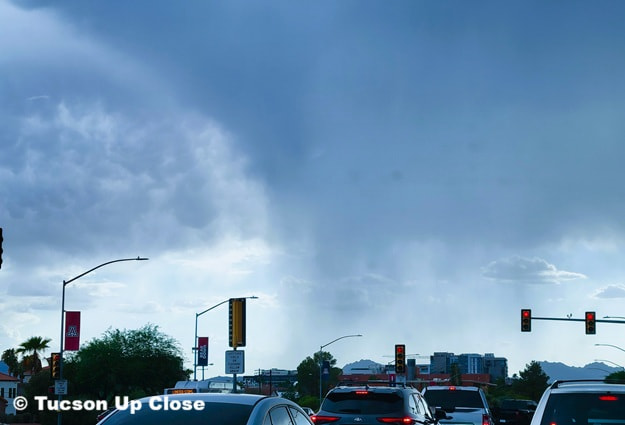 Rain is coming in to Tucson, it's Monsoon Season.
Why Tucson Gets Monsoon Storms
We watch the weather, online or on television, to see if high pressure is at or near the Four-Corners area - where the borders of Arizona, Utah, Colorado and New Mexico meet. That's when you know the conditions are right.
- Moist tropical air moves into southern Arizona, raising humidity and the dew point
- Extreme summer heat causes rising air
- Mountain ranges help trigger thunderstorm development
- Storms often build during the afternoon
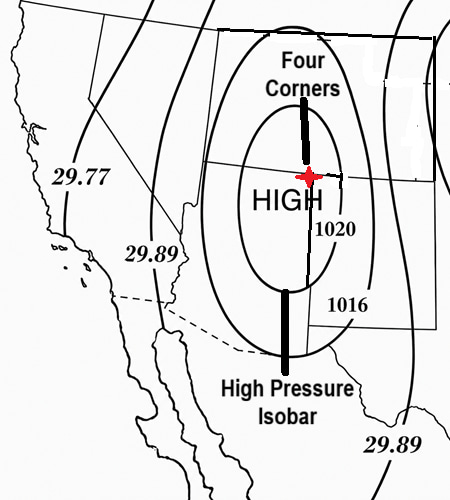 Getting perfect conditions for a Tucson monsoon.
What Makes Tucson’s Monsoon Unique
After June, Tucson's hottest month, everyone yearns for monsoon weather to start. Because then we'll experience
- Sudden temperature drops, even as much as 30oF/17oC, with an intense downpour.
- Dramatic lightning displays all across the night skies.
- Intense rainfall that may last 15 minutes - or 3 hours - sometimes even more.
 Fast-moving flash floods in desert washes.
However there are some other cautions to recognize. Be aware of these possible conditions:
- Dust storms are rare, and the recent local weather forecaster has now been calling them “haboobs.”
- An Arabic word, but we still call them dust storms.
When Is Monsoon Season in Tucson?
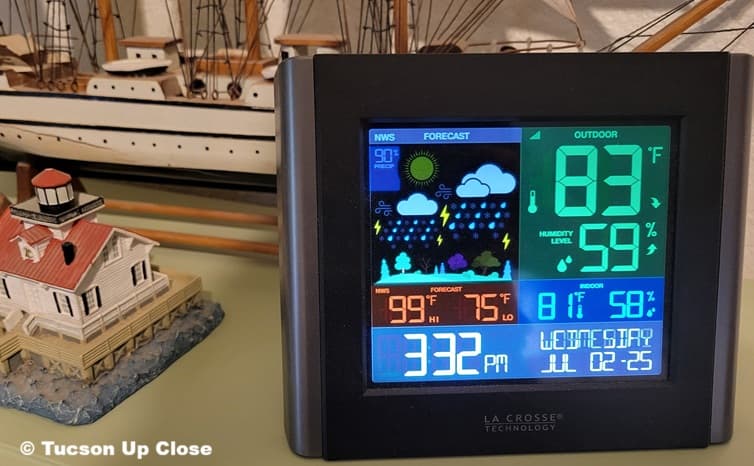 Our home weather station has a good prediction of rain - July 2.
Tucson’s monsoon season via the National Weather Service, officially begins on June 15 and ends September 30.
But think of July fourth as the practical beginning. Or one or two days before or after. Ask a long-time local and they'll tell you to watch those clouds building on July 4th. And then by dinner time, thunderstorms arrive!
In fact, years ago I did my own unofficial study - looking at monsoon start days over the past 50 years or so. Which day came out on top - for the most starting days for monsoon? July 4th!
Less often a monsoon storm will start up in June, but the peak storm period occurs from July and August. Then September can still bring in some storms.
If you'll visit during these months, you can expect:
- Building afternoon clouds
- Thunderstorms midday bring wonderful temperature drops during a storm
- Often the rain and lightning come in around sunset
- Sometimes it will storm overnight
Tucson Weather by Monsoon Month
JUNE
- Very hot - the hottest month of the year - and mostly dry
- Humidity just begins increasing
- Because there's little to no rain and windy days, dust storms are possible late in the month
JULY
- Storm activity increases rapidly
- Frequent afternoon thunderstorms
- Higher humidity levels and increasing dew point
AUGUST
- Can be the wettest monsoon month
- Strong lightning and heavy rain possible
- Desert vegetation becomes greener, the surrounding mountains now look more green than gray
SEPTEMBER
- Storms gradually decrease
- Humidity drops
- Temperatures slowly begin to cool down
What Does Tucson Look Like During Monsoon Season?
Monsoon season changes the appearance of Tucson and the surrounding Sonoran Desert dramatically.
- The first thing is the cloud cover that begins arriving. Not exactly overcast, but lots of clouds above which help block out the sun. That helps restrict highest temperature, as these clouds can make it feel a bit "cooler."
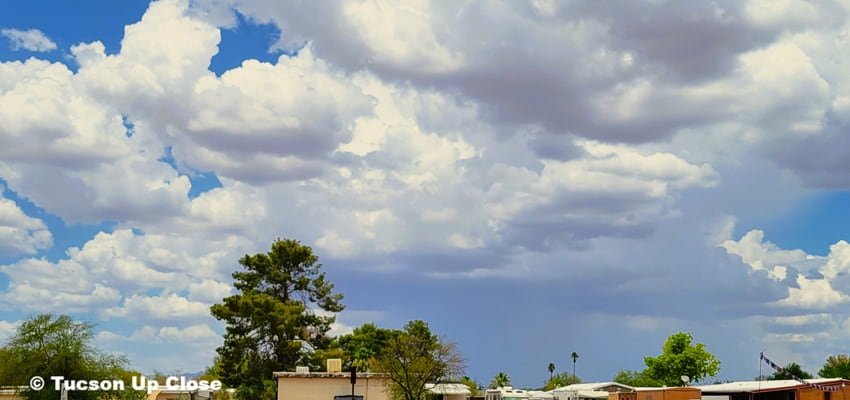 Monsoon clouds over Tucson with distant rain on its way.
- As rain approaches, the scent from creosote bushes can reach your nose - sort-of like a rain-predictor! Locals typically say "I smell rain!" in happy anticipation.
- As rain begins to arrive, you'll notice you can observe rain showers popping up here - or there, in the distance. They don't always come in all at once.
- Once the storms begin coming through Tucson, you'll see grass and weedy plants pop up all around. Especially in untended meadow-like areas.
- You'll really notice how sunsets can become even more colorful, when some clouds have gone - and the sun shines through. Not just a glowing red sky, but pinks - purples - yellows - oranges - a multicolored cloud appearance from the sun's reflections. It's truly astounding! To see more about this, Download Our Free Booklet on Sunset Colors.
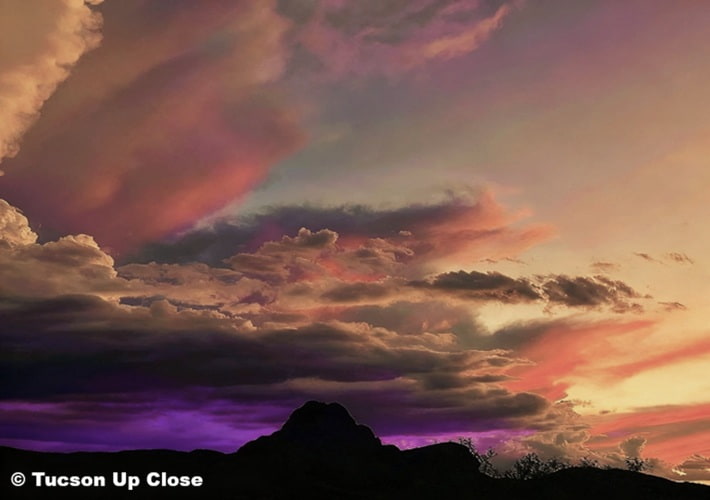 Sunset over Sombrero Peak, after monsoon thunderstorm. Taken from our daughter's backyard.
For transparency, I did have my camera set to "vivid." It was naturally nearly that stunning anyway.
You'll enjoy the desert landscapes turning greener as rainfall increases. And love the mountainous clouds towering over the city. And be amazed at lightning storms that create a spectacular desert showtime.
Desert Changes After Rain
- Creosote bushes may have already released their scents, but if you didn't get wind of it then, after the storm you'll definitely get a whiff of its famous desert rain fragrance.
- Saguaros puff up with the stored rainwater, appearing brighter and greener.
- Wild grasses grow rapidly.
- Multiple desert washes and dry rivers might suddenly flow with water.
- Rainbows (sometimes double) will often appear.
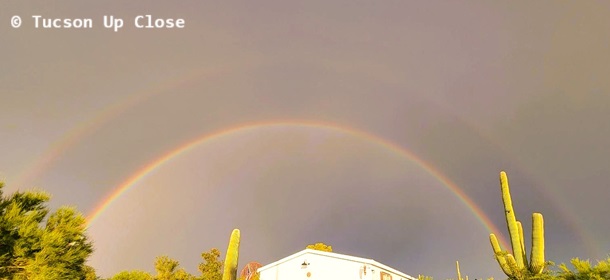 Our son took this rainbow photo over his house.
How Dangerous Is Tucson Monsoon Season?
Tucson monsoon season can become dangerous very quickly. Some storms are short-lived, others can go on for hours. Either way, they may produce:
- Flash flooding
- Dangerous lightning
- High winds
- Blowing dust
- Reduced visibility on roads
Use caution and be aware of possibilities if you're planning afternoon walks, off-road driving, crossing flowing washes or mountain trail hikes when there are storm forecasts.
We recommend you monitor weather forecasts if visiting during monsoon season. Tucsonans usually do that, as well. Yet, as long as you use common sense, watching a monsoon storm come in can be an event!
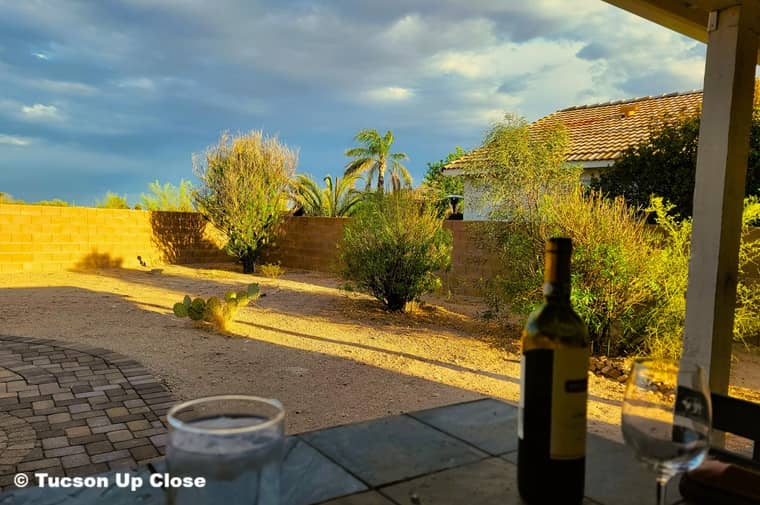 We always enjoy sitting at our back patio bar to watch a monsoon storm.
Flash Flooding in Tucson Washes
Desert washes can flood within minutes, even if rain is falling miles away. The rainfall collects in the mountains and foothills, and quickly flows downward filling up dry creekbeds.
Our advice is: (you'll hear this on weather forecasts and news alerts)
- Never drive or walk into flowing water during storms.
- If you think you can make it, and try - a surge of water may come at any moment.
- People have had their cars (along with themselves) swept away downstream.
- If barriers are up - it's best not to go around them, even if you see others doing that.
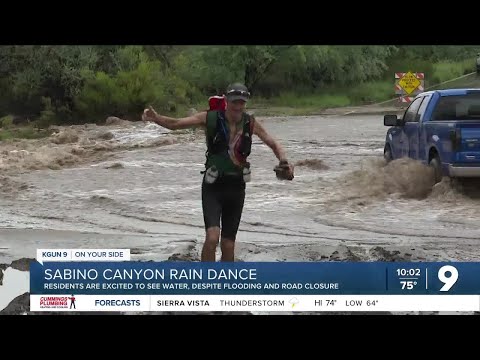
ARIZONA'S STUPID MOTORIST LAW
Arizona has a law they can apply when someone gets caught in a flooding wash. If a rescue is needed, local tax monies are involved. So if people don't observe barriers, and end up being rescued - they can be charged a fine to cover the cost.
Arizona Revised Statute § 28-910 is nicknamed the "Stupid Motorist Law." The law specifically designates it to those that go around barricades placed because of flooding. Unmarked flooded roads don't trigger the statute.
Lightning Safety During Monsoon Storms
Arizona experiences some of the nation’s most active lightning storms during monsoon season. Keep the usual lightning safety advice in mind. And remember, nearby lightning can occur before rain begins.
Avoid:
- Open desert areas
- Golf courses and swimming pools/areas
- Hiking exposed ridges
- Standing under or taking shelter from the rain under isolated trees
For further help, read through our Local Electric Company's Storm Guidance.
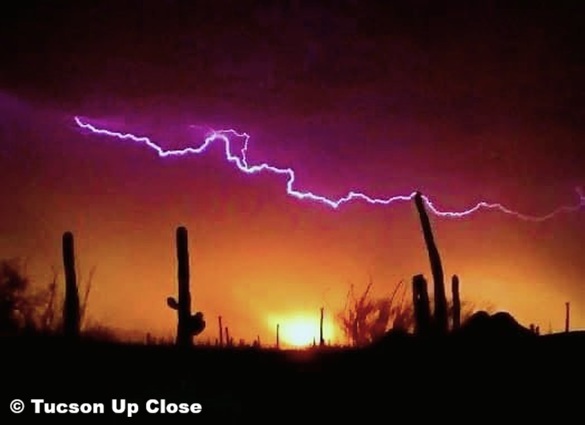 It's difficult to capture lighting by camera if you're not a pro photographer.
But our daughter somehow managed to capture this!
Tucson Dust Storms
Personally, I don't like the word "haboob" used to mean dust storms. Which scientists had adopted for use back in 1972.
They realized our massive summer dust walls behave exactly like the historic storms in the Middle East. Despite my not liking the word "haboob" - it's now an official meteorological term!
It comes from Arabic for "strong wind." Unlike regular windy days that kick up some dusty dirt, a true haboob happens when...
- A summer monsoon thunderstorm collapses.
- Cold air violently rushes out of the storm cloud.
- It hits the desert floor, rushing outward like a wave.
- This creates a distinct, rolling wall of dust that can tower thousands of feet high.
Our local news and Weather Service started using "haboob" in forecasts and warnings in the early 2000s. Because it exactly describes the dramatic quick drop in visibility to near zero.
Long-term drought also creates an increased chance. Altogether they're relatively rare.
Certain areas are more susceptible, like along I-10 where the desert stretches out with little vegetation, like around Willcox, Casa Grande or west of Phoenix.
With Tucson circled by mountains, there's not enough land of that type to easily get one going.
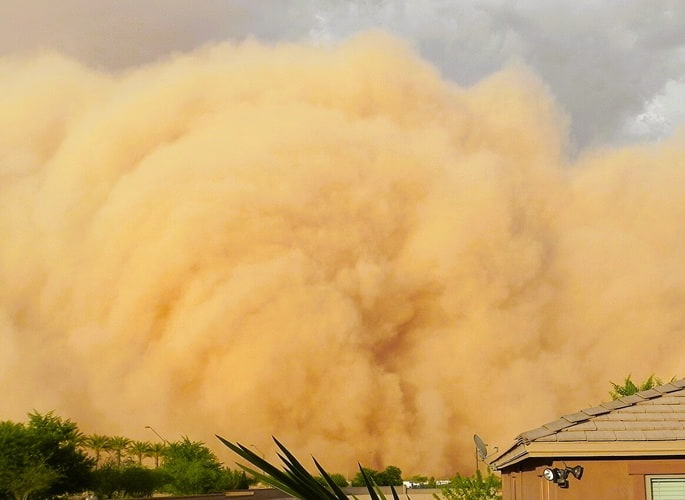 Dust storm coming into Casa Grande (70 miles north of Tucson) on July 5, 2011.
In all the time we've lived in Tucson, I've only noted two visible. Around 1978 or '79 I saw a distant one south of town, never arrived here. Then in July 2021 what's been reported as a dust storm crossed the Tucson valley. We were sitting at our patio bar, and went inside as the sandy dust began hitting against us. We initially thought it was oncoming rain.
If you happen to be driving and see one ahead these are must-do items to stay safe:
- Pull completely off the road
- Turn off lights
- Keep your foot off the brake pedal
- Wait for visibility to improve
More Details at Pull Aside | Stay Alive
Is Monsoon Season a Good Time to Visit Tucson?
Monsoon season can be an excellent time to visit Tucson. In fact we recommend it!
Especially if you love seeing greener desert scenery, taking fantastic photographs, observing lightning storms, and having fewer crowds than winter tourist season.
Advantages include:
- Beautiful cloud formations and storm light-shows
- Cool evenings after storms
- Lower hotel prices than winter
- A different sort of desert weather
However, visitors should prepare for:
- Humidity heightens to near 50% (about a 30%+ climb from winter)
- Heat with a high dew-point (uncomfortable!) before storms
- Sudden weather changes because storms can arrive quickly
- Occasional travel delays because of flooded washes across roadways, or sheet flooding - which spreads inches of water across a whole flat area.
Tucson Monsoon Season Travel Tips
Visitors traveling during Tucson monsoon season should plan around changing weather conditions throughout the entire day.
For instance if you'd like to go golfing, walking or doing some sightseeing - early mornings are the coolest, as well as safest. Before the storms build up.
What to Pack for Tucson Monsoon Season
We recommend these items that will help you enjoy the Tucson Arizona monsoon season:
- Lightweight breathable clothing, especially items that can be layered.
- Lightweight rain jacket - we've used those thin fold-up types for quick zips through the raindrops.
- Sun protection is always needed. Clouds don't protect from sunburn.
- Extra water is always essential, as even with a bit more humidity, dehydration can occur with activity.
- Shoes with good traction.
- Have you best phone weather app downloaded.
Driving During Monsoon Storms
You certainly won't necessarily see locals following all these tips, but we think everyone should:
- Slow down during heavy rain, and allow extra distance between cars. Many Tucsonans don't slow down when it's raining, though they should. You'll hear lots of accidents reported on rainy days.
- Watch for flooded roads and avoid large washes if possible. We advise not crossing running water.
- Know dust storm advisements - just in case.
Tucson Monsoon Season vs Phoenix Monsoon Season
Both Tucson and Phoenix experience Arizona monsoon storms, but there's often a difference.
Tucson generallly receives stronger and more frequent summer thunderstorms because of the surrounding mountain ranges. Plus a more southernly proximity - nearer where the upper moisture comes from.
Compared with Phoenix:
- Tucson is cooler, usually by 10oF/5.56oC
- Tucson usually receives more rainfall
- Tucson storms often develop earlier in the day
- Desert scenery becomes greener faster
Read the Latest


-
Best Botanical Gardens in Tucson for Your Trip
 Get the best botanical gardens Tucson picks, plus local tips on seasonal color, standout stops, and when to visit for the most comfortable outing.
This guide combines local Tucson monsoon experience with weather and safety information from the National Weather Service and Arizona climate sources, as follows...
- National Weather Service (nd). Monsoon. Retrieved from https://www.weather.gov/twc/Monsoon
- National Weather Service (nd). NWS Forecast Office Tucson, AZ. Retrieved from weather.gov/twc/
- Arizona Department of Transportation (2012, June 11). Pull Aside - Stay Alive. Retrieved from azdot.gov/blog-article/pull-aside-stay-alive
- The University of Arizona (2026). Monsoon. CLIMAS: Climate Assessment for the Southwest. Retrieved from climas.arizona.edu/sw-climate/monsoon
- LegalClarity Arizona (2026, April 6). Weird Arizona Laws: From Bathtubs to the Desert. Criminal Law, LegalClarity, retrieved from legalclarity.org/weird-arizona-laws-still-on-the-books/
Frequently Asked Questions About Tucson Monsoon Season
When is monsoon season in Tucson Arizona?
When is monsoon season in Tucson Arizona?
According to the National Weather Service, Arizona’s Official Monsoon Season runs from June 15 through September 30.
But many Tucson locals (like us) will tell you it begins in July, much of the time on the 4th, but at least within 1 or 2 days of that. That comes from observations over the years, and some data analysis as well.
What causes Tucson monsoon storms?
What causes Tucson monsoon storms?
Tucson monsoon storms form when moist tropical air begins flowing northward out of the eastern Pacific and tropical areas of Mexico. That typically happens when a high pressure is sitting on top of the Four Corners area - where the borders of Arizona, New Mexico, Colorado and Utah meet.
This moist air combines with heated desert air rising up with the help of the surrounding mountains. That makes perfect conditions for building up sudden, often powerful summer thunderstorms.
We have some Further Detail on This Weather Pattern.
Does Tucson flood during monsoon season?
Does Tucson flood during monsoon season?
Yes it can and often does.
Heavy monsoon rain causes flash flooding across dry washes, low-water crossings, and/or poorly drained roads. Sheet flooding can spread out over an entire flatter, level desert landscape. Driving through this rushing water can be dangerous.
Are Tucson dust storms dangerous?
Are Tucson dust storms dangerous?
Yes, definitely so. In fact, no matter where they occur.
Dust storms are now called haboobs by Tucson's weather reporters, and by the local National Weather Service. Visibility reduces drastically, quickly to nearly zero. Creating seriously hazardous driving conditions.
That's why there are specific advisements to "Pull Aside to Stay Alive."
Fortunately Tucson doesn't experience many haboob types of dust storms. There needs to be lots of flat, minimally vegitated areas. Tucson is somewhat hilly and surrounded by mountains that help block dust storms from beginning.
We have A Section Here That Tells You More.
Is monsoon season a bad time to visit Tucson?
Is monsoon season a bad time to visit Tucson?
Not necessarily.
And to us, as local Tucsonans - not really. Many travelers enjoy Tucson during monsoon season because of dramatic skies, lightning storms, greener desert scenery, and lower hotel prices.
We love traveling, but always stay in town for monsoon season in Tucson. We love the opportunity for the dazzling storms, the rain, and the cooling temperatures.
The Takeaways for Tucson Arizona Monsoon Season
Monsoon season can be a wonderful time to come have a visit to Tucson AZ. The weather is somewhat cooler overall. And to watch a monsoon storm can be an exciting, wonderful experience.
If you're not used to the desert monsoon, it's good to be aware of the things we spoke about.
- What time of year is the Tucson monsoon?
- What to pack for this season?
- Being safe during a storm, like with floods and lightning.
- Know about dust storms.

About the Authors: Karen McGowan is the creator of TucsonUpClose.com, along with her husband Bill. Where they share local details about Tucson Arizona gained from years of living in town. To this day, they actively sample all that Tucson AZ has to offer, so they can help others have a wonderful, relaxing trip to Tucson - suited to their preferences. Learn more about us.